1 tip & 3 resources per week to improve your Strategy, OKRs, and Discovery practices in less than 5 minutes. Explore my new book on realprogressbook.com
How does "Taste" Show up in Products?
How does "Taste"
|
Dear Reader,
I'm in the early stages of developing a new talk titled "5 Theses on what remains Human in Product Management" for the Digitale Leute Summit 2026. While I'm working myself up to the five theses, one that I'm certain will make the cut is around taste.
Yes, yes - I know how capable Claude Design is. But when was the last time you looked, truly looked, at a product you used and you felt the craft that was put into it? That a team of people poured their hearts and souls into creating an experience that would touch you and wouldn't just be touched or clicked by you?
Exactly - rarely. And, I get it. Currently, the majority of product requirements focus on efficiency. On speeding things up. On making products smarter. But, under the surface, many use the same foundational models, which leads to similar behaviors and results. Even more so, the surface layers become similar as well. Leading to something Peep Laja called the "sea of sameness" a long time ago. And I think many products are (or will be) drowning in it.
Thinking back to the early days of my career, three products stand out to me for how much they cared about the distinctiveness of the "surface."
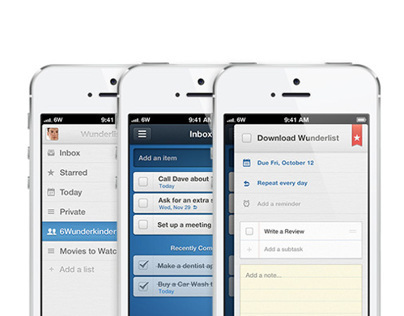
Wunderlist: Obviously, a design from about 15 years ago looks dated today. But the team at Wunderlist always created an incredible feel in their apps (across platforms), while adapting to new operating systems and design standards:
 |
iA Writer: Maybe my favorite example for how taste and a POV can stand the test of time. It was minimalist when it launched in 2010. It is minimalist in 2026. And it took them 15 years (!) to become an Apple Design Award Finalist. It is my favorite all-time app to this day, and if you want to get closer to truly understanding obsessive taste, I recommend this keynote by iA's founder and CEO Oliver Reichenstein, from the 2024 Product at Heart.
 |
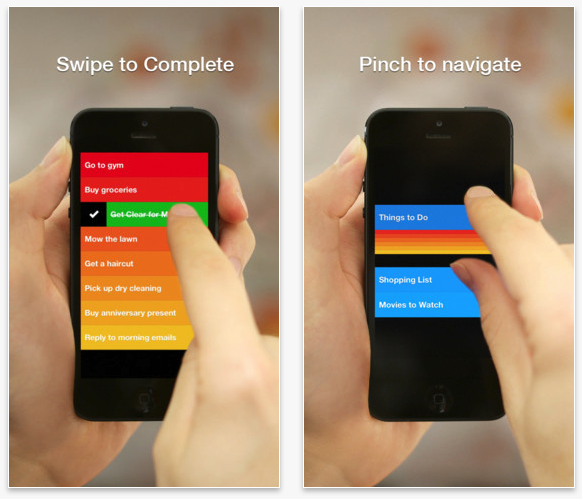
Clear: This was an app that had me running around, showing it to colleagues, because of the excitement over its approach to task management. Launched in 2012, it quickly got copied. But that didn't matter, since the taste it embodied was timeless.
 |
These days, the only product I use on a regular basis (and can speak to), besides iA Writer, that truly embodies taste and where I can feel a POV is Airbnb. I might not agree with all their design choices, but they certainly make choices.
So...how does taste come together? No matter what you might find online, I believe taste is hard to learn. Not because it's such an elite skill, but because you either have a natural knack for it (like some people have a knack for being an operator vs. a visionary), or have spent years getting your hands dirty creating more misses than hits.
Taste is hard to teach but possible to develop. I believe taste isn't something you can download by taking a course, reading a beautifully crafted Perplexity summary, or prompting your way to a style guide in Claude Design.
I also believe taste is less a matter of skill and more a matter of a distinct Point of View (POV) and carrying that conviction all the way through the product creation process.
And I believe that the taste showing up in the surface of a product can quickly get overlaid by productivity-boosting AI functionality, when not added thoughtfully (my "favorite" example for this being Notion).
Sure, taste alone doesn't create a winning strategy. Factors like distribution, switching costs, pricing models, and fundamental problem-solution fit are real factors. But as we move through a world where the beneath-the-surface capabilities get commoditized by the hour, I'm convinced that taking ownership of how taste shows up in your product can tip the scales.
Taste might not guarantee economic longevity, but I'm certain it increases your chances of sticking out in the sea of sameness many of us swim in these days.
I would love to read replies about your favorite everyday product (whether it's digital or physical) that represents and embodies taste for you.
Thank you for Practicing Product,
Tim
As a Product Management Coach, I guide Product Teams to measure the real progress of their evidence-informed decisions.
I focus on better practices to connect the dots of Product Strategy, Product OKRs, and Product Discovery.
Product Practice Newsletter
1 tip & 3 resources per week to improve your Strategy, OKRs, and Discovery practices in less than 5 minutes. Explore my new book on realprogressbook.com
Product Practice #417 User Outcomes are Positively Flipped User Problems PUBLISHED Jul 17, 2026 READ ON HERBIG.CO Dear Reader, Last week, I mapped how OKRs connect to the layers of an Opportunity Solution Tree. But especially the Outcome layer deserves its own issue: turning a customer problem into a team-level Key Result. I first wrote about it in 2023, before I had a name for it. Since then, the positivity flip has become one of the most-used tools in my OKR and Discovery workshops, so...
Product Practice #416 How to Connect OKRs to OSTs PUBLISHED Jul 10, 2026 READ ON HERBIG.CO Dear Reader, OKRs (Objectives and Key Results) help you measure strategic progress. OSTs (Opportunity Solution Trees) are a visual structure for connecting solution and problem spaces to business goals. Let me break down how the layers of an OST connect to the practices of OKR drafting and execution: Layer 1: The Outcome Teresa differentiates between business outcomes, product outcomes, traction metrics...
Product Practice #415 Accelerated Context and the Validation Sparring Partner PUBLISHED Jul 3, 2026 READ ON HERBIG.CO Dear Reader, Most of the AI conversation in product management right now is either describing doomsday scenarios, exaggerated improvements, or warning about what might go wrong. But I am more interested in what changes for product teams doing real work. When a product team adopts an AI tool, what specifically changes about their day? What benefit do they keep coming back for,...