Business Value, Customer Value, and Team Value Are Different Arguments
Dear Reader,
As long as everyone focused on Value you can't do the wrong work, right? RIGHT? Well, as lovely as that sounds, I believe there's a tremendous amount of misdirected focus on value going on in teams. Let's dive into it.
Three questions hide behind "value" in most conversations:
- Did this move a number the business gets paid on.
- Did customers change what they do because of it.
- Did the way the team built it make them better at building the next thing.
I like to call them business value, customer value, and team value. That doesn't mean I want to establish universal correctness, but a shared language.
Business Value
These get used as a universal umbrella for decision-making, independent of their actual clarity. Revenue is slow to move and hard to pin on one feature, so a rigorous-looking number fills in: features shipped, story points closed, tokens burned through a model.
Of course, token usage is the current favorite. It's an input metric. You can spend a lot of it and produce nothing, let alone a customer who behaves differently or a dollar that shows up anywhere. Fine to watch as a cost line. Not a substitute for the question it's standing in for.
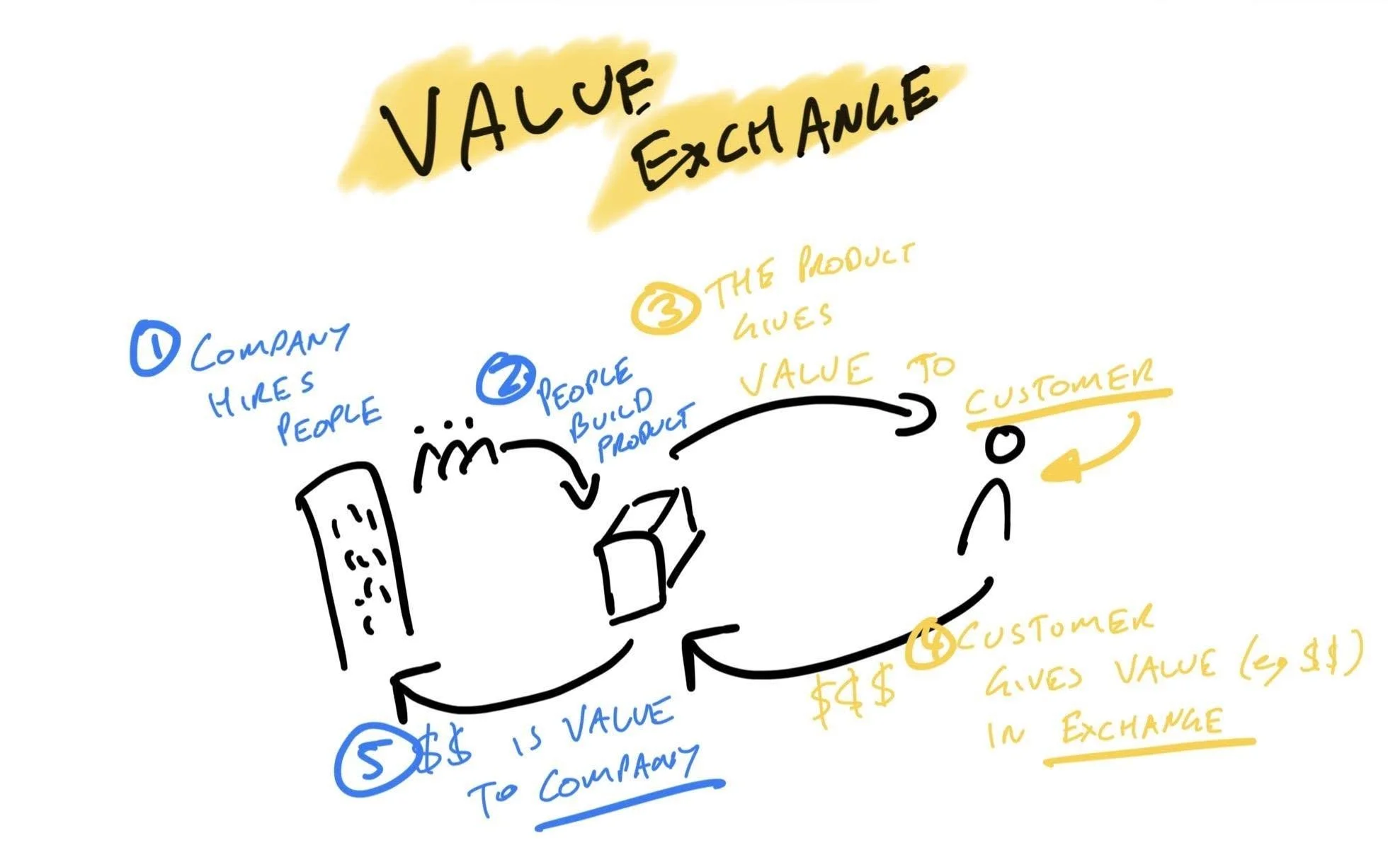
Because the value exchange happening here is imbalanced: Yes, you get compute power from the LLM, but they receive your money and data, which carry value automatically. Keeping Claude busy for hours doesn't automatically generate value for you or your employer.
Customer Value
Shipping more doesn't automatically create this one either, by default. Ship ten features, and many companies I meet already had an adoption problem before feature ten arrived (imagine that problem getting hyper-scaled by 10x releases). Customers who don't notice a feature don't get value from it, and non-adoption increases churn, one renewal at a time. The test of a release isn't whether the feature shipped (never was, but we didn't care). It's whether someone is faster or better at a task they were already trying to do.
Team Value
Call it a speedtrap: A prototype that used to take two weeks now takes an afternoon, whether that's a vibe-coded mockup, or a design exercise compressed by better tools. But faster prototyping still only answers usability questions (unless you trust synthetic users, which you shouldn't, yet): can people use this? It doesn't speed up desirability or willingness-to-pay per se, because that still depends on the "waiting time" for changes in your target audience's behavior. So, you can get to the wrong answer faster, and you've made the same mistake at higher velocity, with less time to notice before you've committed to it.
Demystifying Value
None of these values is more correct than the others. Without creating business value, you won't be able to create customer or team value. Without creating customer value, you won't drive business value. And without team value, you won't have improvements in the people doing the work that are required for everything else.
So, next time you want to prioritize value, I invite you to be explicit about value for whom. And, more importantly, be clear on how you will actually know you created that value.
Thank you for Practicing Product,
Tim
Ways we can work together
1️⃣ Order my book: Real Progress: How to Connect the Dots of Product Strategy, OKRs, and Discovery, which readers call "a practical guide you can return to again and again."
2️⃣ Learn how to go from Strategy Choices to De-risked Assumptions in my 3-day Live Workshop, where you'll work with assembled strategy components, enabling a clear no and prioritized assumptions, and how to test them.
3️⃣ Join the 1-day Workshop The AI-Powered PM: From Hype to Agentic Application I'm co-teaching with Julia Bastian, to cut through the AI noise, run better AI-assisted discovery, and build your first agents and automations for the highest-leverage tasks in your work and your team's sphere of influence.
4️⃣ Learn about my in-house training and coaching options for product teams, with a focus on creating strategic clarity, setting pragmatic goals, and implementing real-life discovery practices to reduce risk
|
|
As a Product Management Coach, I guide Product Teams to measure the real progress of their evidence-informed decisions.
I focus on better practices to connect the dots of Product Strategy, Product OKRs, and Product Discovery.
|