1 tip & 3 resources per week to improve your Strategy, OKRs, and Discovery practices in less than 5 minutes. Explore my new book on realprogressbook.com
🛠️ How to Turn Company OKRs into Product OKRs
| Product Practice #307 |
How to Turn Company OKRs into Product OKRs
Dear Reader,
Happy 2024 (if we can still say that 😅)! I hope you had a great time over the holidays. Personally, I enjoyed the time off with my family during Christmas. In January, I spent time by the sea, made the most of the snow we got with my son, inspected the location for our wedding in March, and was focused on hosting my 3-day in-person Strategy/OKRs/Discovery workshop in Berlin.
But now I'm more than happy to be back in your inbox and to tackle practical topics in each issue. Having said that, let's dive into today's newsletter:
There are two fixes when teams can’t influence their Key Results because they are out of reach:
- Expanding their Sphere of Influence through shared OKRs
- Shrinking the out-of-reach KR into their Sphere of influence
This newsletter is about the latter.
Let’s look at a large e-commerce product:
One of the company-level KRs is to “Increase the conversion rate from homepage to completed confirmation by 7%.”
Between the homepage and the purchase confirmation page, the “ideal” user journey might consist of five steps: searching for a product, viewing a product detail page, adding the product to the cart, starting the checkout, and completing the checkout.
For every team responsible for site sections along the journey, setting up their KRs with tiny contributions to the overall +7% might be the obvious choice. For example, the checkout team might want to contribute 3% since they are the closest to the final purchase.
But that’s a loser's game since the general conversion rate increase depends on more than “just” what’s within the zone of control or even the sphere of influence of this (or any individual) team. No matter how you slice it, the overarching KR will always only remain within the area of contribution for any particular team–rendering any broken down KRs of that metric pointless since the team can’t use it to measure THEIR progress.
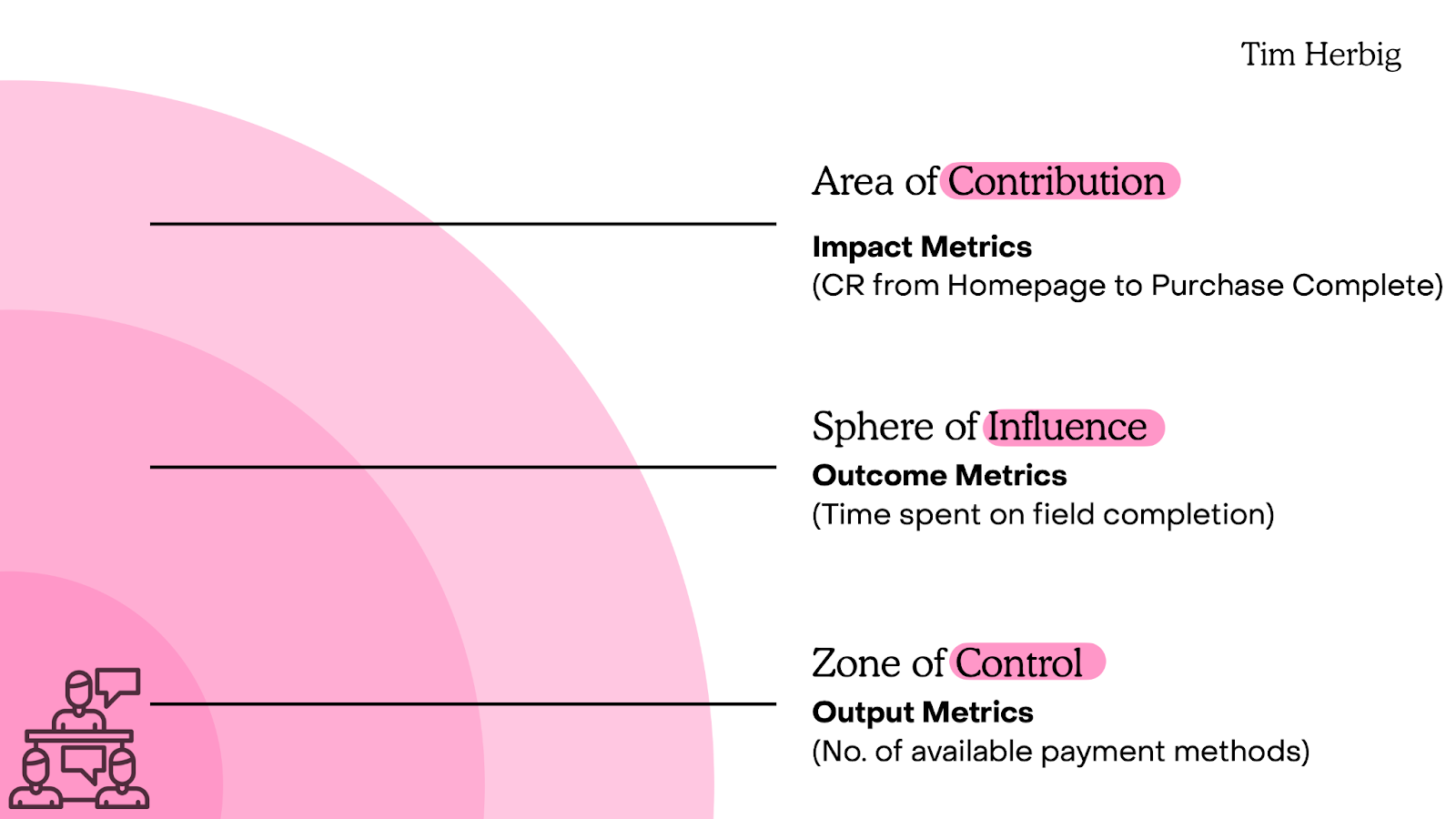
Instead, the checkout team needs to shrink the company metric by reinterpreting the intention expressed through the KR along their zone of control and sphere of influence.
For example, they can INFLUENCE the time spent on the checkout page, the payment validation error rate, or the conversion rate from checkout started to complete.
They can also CONTROL the number of mandatory address fields shown, the payment methods offered, or the checkout's loading time.
 |
Let’s assemble the pieces:
The Area of Contribution consists, among others, of the Impact Metric: “Increase the conversion rate from homepage to completed confirmation by 7%.”
Within their Sphere of Influence are Outcome Metrics, such as “Reduce time spent to complete address and payment details by 13%.”
Within their Zone of Control are Output Metrics like “90% of all requested payment methods are available in all markets.”
Thank you for Practicing Product,
Tim
How to Dive Deeper into OKRs
Learn the strategies and tactics you need to use OKRs in a way that helps product teams prioritize work based on user problems and business goals—instead of replicating existing feature backlogs.
My Outcome OKRs for Product Teams Course enables product teams to use OKRs as a tool for decision-making in the context of Product Strategy, Product Discovery, and Scrum. Without the fluff, but with a focus on practicality in everyday work.
| Learn more about my OKRs Course |
What did you think of this week's newsletter?
As a Product Management Coach, I guide Product Teams to measure the progress of their evidence-informed decisions.
I identify and share the patterns among better practices to connect the dots of Product Strategy, Product OKRs, and Product Discovery.
Product Practice Newsletter
1 tip & 3 resources per week to improve your Strategy, OKRs, and Discovery practices in less than 5 minutes. Explore my new book on realprogressbook.com
Product Practice #429 Linked Better Practices over Stacked Best Practices PUBLISHED Oct 11, 2026 READ ON HERBIG.CO Meet Me Next Week at Just Product 2026 Get your Ticket Dear Reader, When a leadership team wants to introduce OKRs, it can be tempting to start by turning every bullet point of your strategy into an OKR. But a long list of priorities will still compete for the same time and attention, even when it gets repackaged. Before moving into OKR drafting, I like to work through this...
Product Practice #428 Linked Better Practices over Stacked Best Practices PUBLISHED Oct 5, 2026 READ ON HERBIG.CO Dear Reader, Sorry for the slip in sending this one out on Friday. To make up for it, there will be (for the first time ever) two newsletters going out this week. Recently, a CPO told me about an engineer who had used AI to develop a proposal. But when the decisions in it were questioned, the engineer kept referring him back to the output. The CPO wondered how that conversation...
Product Practice #427 Your Strategy names one audience; weak evidence describes another PUBLISHED Sep 24, 2026 READ ON HERBIG.CO Dear Reader, One of the most common questions that came up in my recent Strategy to Execution workshop at the ProductLab conference revolved around intentional strategic audiences vs. reactive chasing of new business. Many teams either operate where the company focuses on all customers of a given market (i.e., "all lawyers") or throw a wishful-thinking segment out...